TRIDENT 1.0 established that diabetic kidney disease is biologically heterogeneous and that tissue-derived molecular features are tightly linked to outcomes. TRIDENT 2.0 asks what therapy does inside the human kidney: paired kidney biopsies before and after six months of a kidney-protective drug, read at every molecular layer against an untreated re-biopsy comparator.
Adults with biopsy-confirmed diabetic kidney disease receive six months of dapagliflozin, then a repeat research biopsy. The primary outcome is the change in the kidney tissue molecular fingerprint; secondary outcomes are change in eGFR and proteinuria and the feasibility of the paired-biopsy design.
A TRIDENT 1.0 sub-study of 30 participants undergoes a research re-biopsy without a new therapy, profiled by single-nucleus RNA and chromatin multiome, so that drug effect can be separated from time and from the biopsy itself.
Exposure to RAAS blockade, SGLT2 inhibitors, GLP-1 receptor agonists and non-steroidal MRAs across TRIDENT 1.0 is linked to tissue-level molecular signatures, so that the effect of each class on kidney biology can be read in humans.
The engine built for dapagliflozin, paired biopsies with single-cell, spatial and proteomic readouts, is designed to be applied to incretin-based and other kidney-protective therapies next.
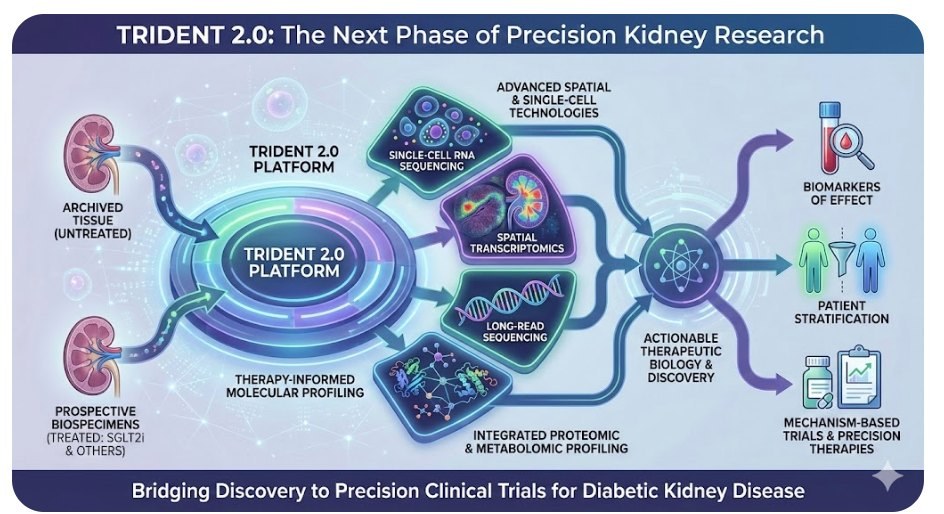
TRIDENT 2.0 is not a separate study but the next stage of one evolving platform. By interrogating how treatments reshape kidney molecular pathways in humans, it builds the bridge between discovery, biomarkers and precision clinical trials.